Chng Seok Tin is part of diverse, local art landscape
, The Straits Times
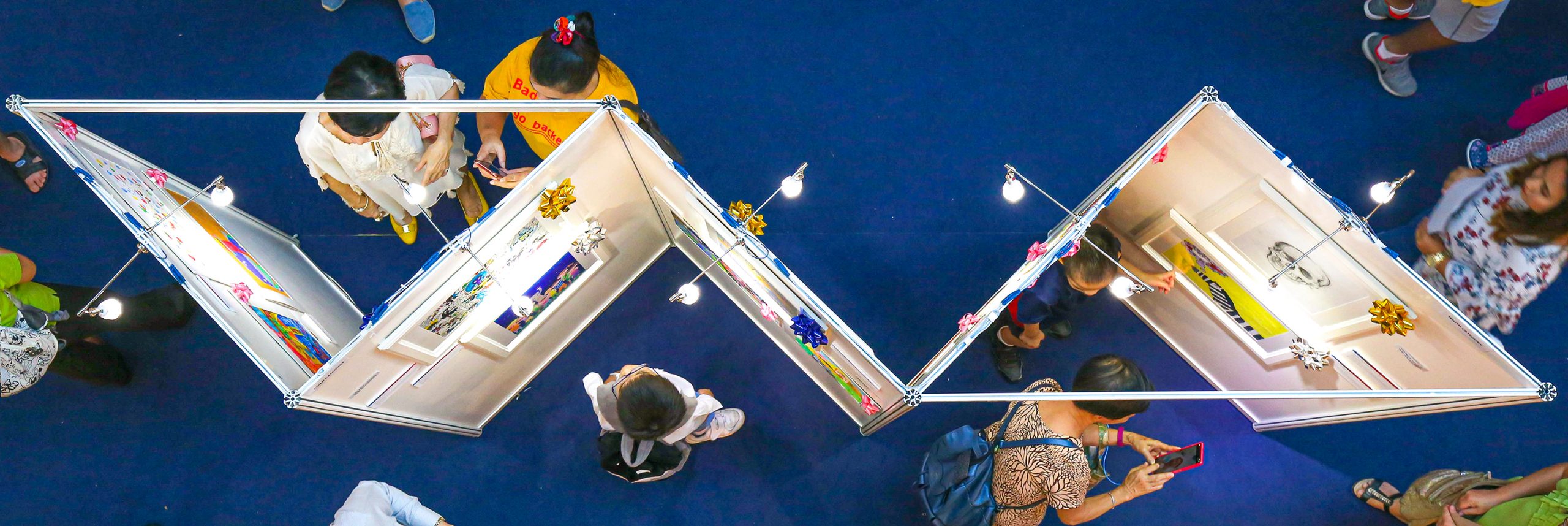
Looking at the works of the late artists Lim Yew Kuan and Chng Seok Tin – both Cultural Medallion recipients – one can see the evolution of the very diverse visual arts landscape in Singapore. Both artists headline new exhibitions. Taking A Retrospective Glimpse Of Lim Yew Kuan’s World Of Art is on at the Hai Hui Art Gallery till December 10, while Through All Vicissitudes: Prints & Sculptures By Chng Seok Tin is on at artcommune gallery till November 27.
Born in 1928, Lim studied at the Nanyang Academy of Fine Arts (Nafa) in 1948 and his early works, like many of those in his generation, were steeped in the Nanyang style – best described as a Singapore version of Impressionism – as well as in the realist style. He took over as the second principal of Nafa between 1963 and 1979 after his father, the pioneer Singapore artist and first Nafa principal Lim Hak Tai, died in 1963.
In 1958, the younger Lim went to Britain to study at the Chelsea School of Art, London, and graduated with National Diplomas in both design and printmaking. Fellow artist and friend Yeo Hoe Koon, 87, says: “He went to the United Kingdom to further his studies and was strongly influenced by Western art. Many of his artworks are the perfect combination of Western and Nanyang styles. This has become the unique Lim Yew Kuan style.” In all of Lim’s works, he is the consummate observer.
Chng, however, was more interested in the interiority of the mind. Like many artists of her generation, her art is more conceptual, even though she and Lim are just 18 years apart.
Born in 1946, Chng studied at Nafa as well, graduating in 1972. In 1975, she began an extensive course of study overseas at art institutions in London and Hull in Britain, and New Mexico and Iowa in the United States. In the retrospective exhibition of her work, presented jointly by non-profit organisation ART:DIS and artcommune gallery, examples of her early material from the 1970s already suggest an exploration of the human psyche. In a woodcut print from 1987 titled Mask, there is even a reference to the Expressionist artist Edvard Munch’s The Scream. Ms Ma Peiyi, curator at artcommune, says that while themes of nature and landscapes are apparent in her work, Chng also “reflected on the trappings of human desires and existential conditions”.
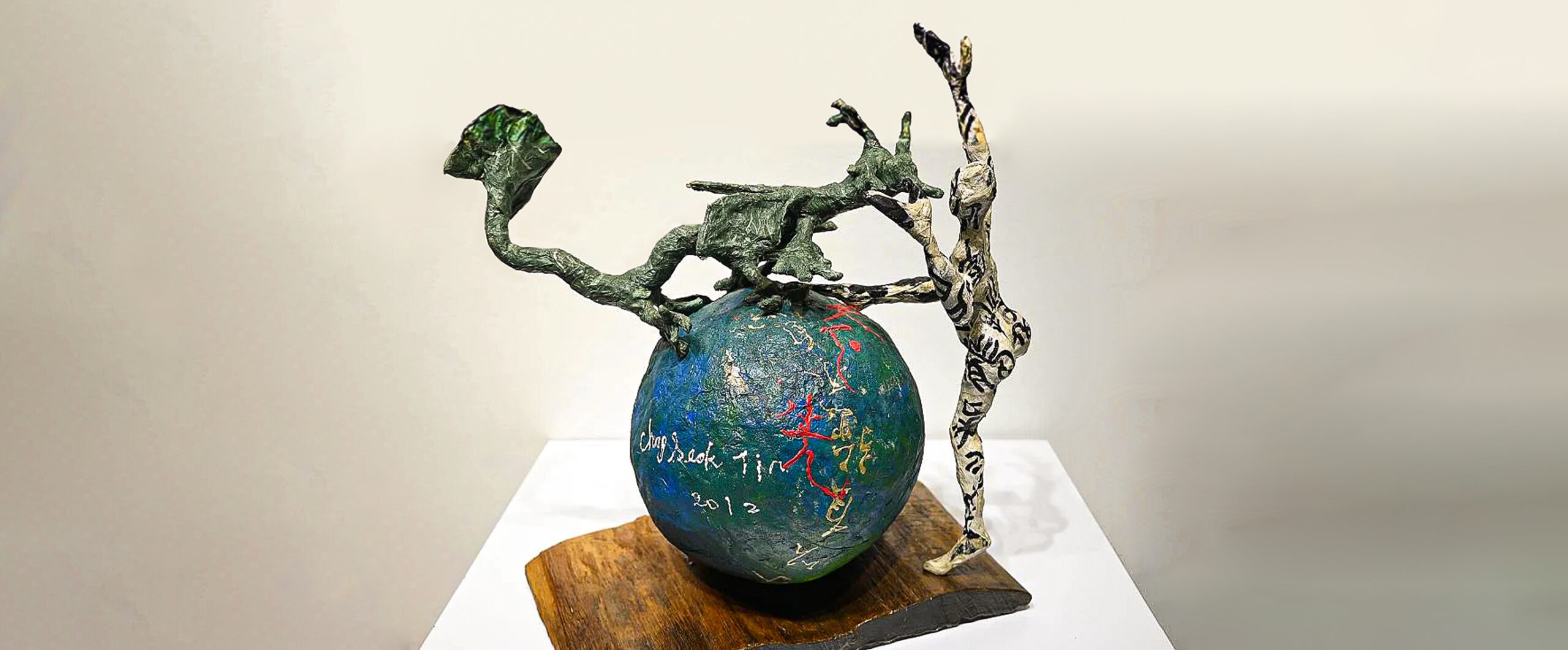
She returned to Singapore in 1986. In 1988, a traumatic fall as she was catching a bus rendered her first partially blind, and later completely blind. Working more with sculpture after the accident, Chng continued her art practice while wrestling with her demons. In a mixed-media sculpture titled Whispering – Let Me Tell You A Secret, Your Dragon Majesty (2012), the demon takes the form of a dragon.
Both exhibitions feature definitive works and each stands on its own. But to view both is to see how Singapore artists have evolved, especially during the early decades of Singapore’s independence. Lim’s work seems to depict his world as an idyll with hints of nostalgia. Chng, on the other hand, has said for an exhibition catalogue in 2011: “All I know is that I am devoted to artmaking, and I do not really care if my works adhere to the aesthetic standards of most people.”
Chng did care about other artists with disabilities though. Ms Angela Tan, executive director at ART:DIS (formerly known as Very Special Arts Singapore), says Chng was “a strong advocate of artists with disabilities, and recognised that they faced additional challenges in professionalising”. Proceeds from the sale of works in Chng’s exhibition will go towards an ART:DIS education fund to support the professional development of emerging artists with disabilities in industry mentorship programmes. The works are priced from $1,800 to $10,000. Paintings for Lim’s exhibition, which are from his family’s private collection, are priced from $3,000 for a woodblock print to between $26,000 and $60,000 for oil paintings.