
Four out of five stars for Chachambo
, Bak Chor Mee Boy
There’s saying that music is the universal language of mankind, allowing people to connect through song and symphony. Nowhere does that seem more clear than in ART:DIS’ Chachambo: Taking Flight, which brings together hit songs and dance numbers in a single, moving story, that proves disabled performers are just as capable of non-disabled performers. Directed by Peter Sau, and written by Claire Teo, the music theatre is a classic tale of triumph in a world where the odds seem stacked against you.
As a production featuring so many disabled artists, audience accessibility is high on the list of priorities, with both creative captioning that visually captures the mood and tone of the lines, utilising colour and font size to good effect, as well as live translation by our narrator, the club concierge (played by Jo Kwek). Jo opens the show by giving a quick introduction to the setting, putting our minds in the right timeframe, as we mentally prepare to travel into the past and let the show begin.
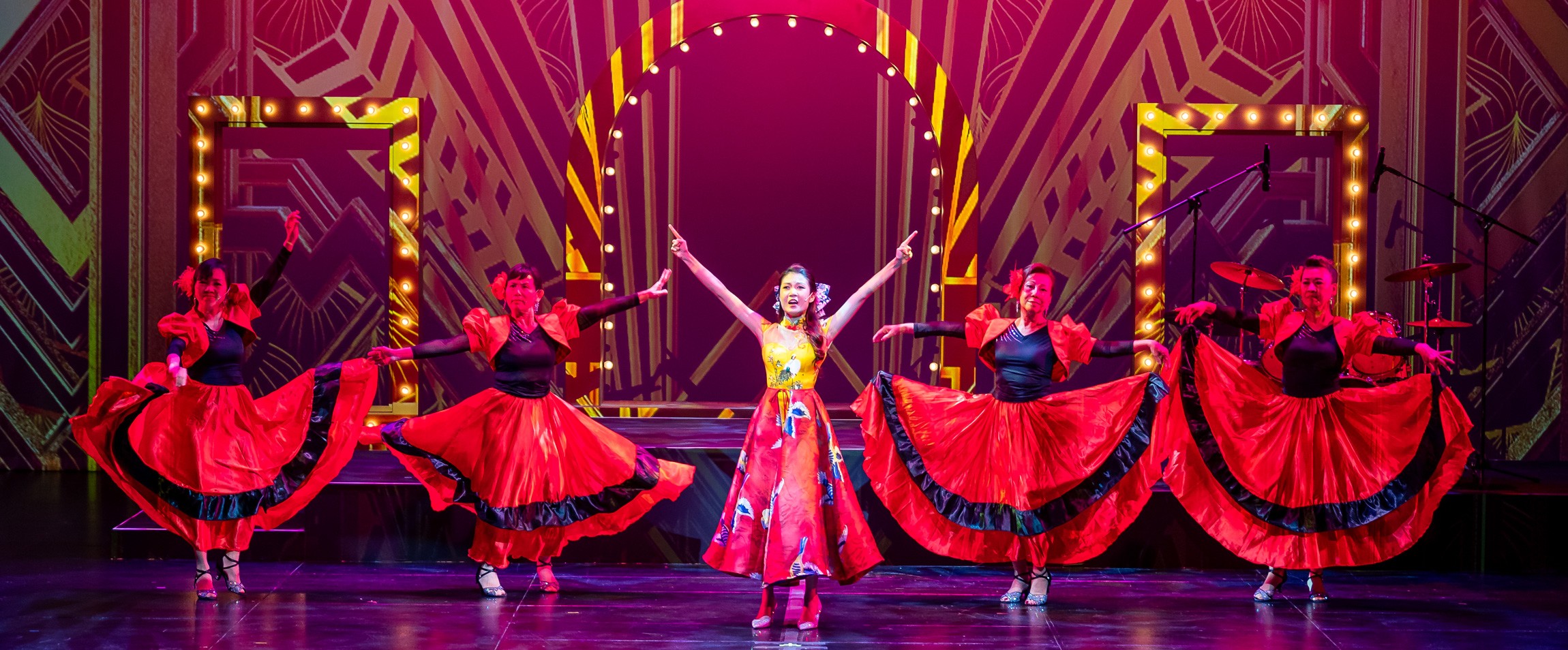
Chachambo‘s storyline spans decades and generations, and its cast manages to match that sense of the epic with their performance. We begin in tragedy, with an introduction to the blind Ming Zhu (played by Claire), poised to take over the club (named Jin Hua Yuan) she inherits from her late mother. As the lights dim, Claire shows off her vocal prowess with a rendition of ‘Habanera’ from Bizet’s opera Carmen, a class act that showcases Ming Zhu’s fiery personality and determination to not let any challenge pull her down.
There is a clear sense of onstage chemistry between the performers, where we see the backup dancers bantering with Claire, or even utilise the violin as part of the ‘conversation’, showcasing how many different forms of communication are present. Interspersing the present and the past, Chachambo takes time to explore both Ming Zhu and her mother Bao Yu’s backstories and struggles. For Bao Yu (played by Germaine Goh, Luo Mang, Wan Wai Yee and Yeo Yann Yann at different stages in her life), an early romance gone wrong leaves her with a heart of stone, her innocence shattered after putting all her trust in her lover (Timothy Lee). As the young Bao Yu, Germaine Goh brings a sweetness and charm to the role, and our heart breaks alongside hers when she is betrayed.


It is interesting then that Ming Zhu resents her mother in the present, emotionally singing Yoshiko Yamaguchi’s ‘Three Years’ while rejecting her mother’s pressure to study abroad and place all her bets on a good education. Even worse perhaps, is the end to Ming Zhu’s own first relationship, with deaf dancer Ali (Ammar Ameezy). This is a relationship that resonates well with the audience, as their meeting begins with hugs, drinking Kickapoo Joy Juice (drawing the laughs from the audience at recognising it), and most of all, a blossoming romance expressed as they dance to P. Ramlee’s ‘Getaran Jiwa’. As they sing, dance and sign together, it feels as if their souls are connected, the song in their heart, only to be forced apart by Bao Yu.
One of the major themes of Chachambo revolves around the idea of freedom, expressed through the unbridled expression performers showcase through song and dance. Beyond the performers’ own abilities, the design team has work to ensure optimum conditions for this to happen. From first glance, Dorothy Png’s set already feels like it’s been optimised for its diverse cast, giving them as much room as possible to express themselves, easy to navigate. Max Tan’s costume design gives all the performers enough flexibility to move, while also integrating his keen sense of fashion and design sensibilities into them, such as chic lined dresses reminiscent of the era, or incorporating patterns such as polka dots and stripes, each outfit telling a story in the clothing choice alone.
With a choir and the entire 90-member strong ensemble onstage, regardless of disability, Chachambo ends with the title song, celebrating these diverse lives and performers, their unique forms of expression and their artistry, filled with joy as they dance and sing together as one community. This is not a charity show to evoke our pity. This is a full-fledged performance that proves to audience members that with determination and hard work, the disabled community stands strong and are more than capable of putting on a theatre show anyone would be impressed by. It takes a village, but with courage and resilience, more help, understanding and enabling, we can move closer towards recognising disabled artists as professionals in their own right, and champion ART:DIS’ cause of empowering the community.