
Growing audience awareness and support for artists with disabilities
, Lianhe Zaobao
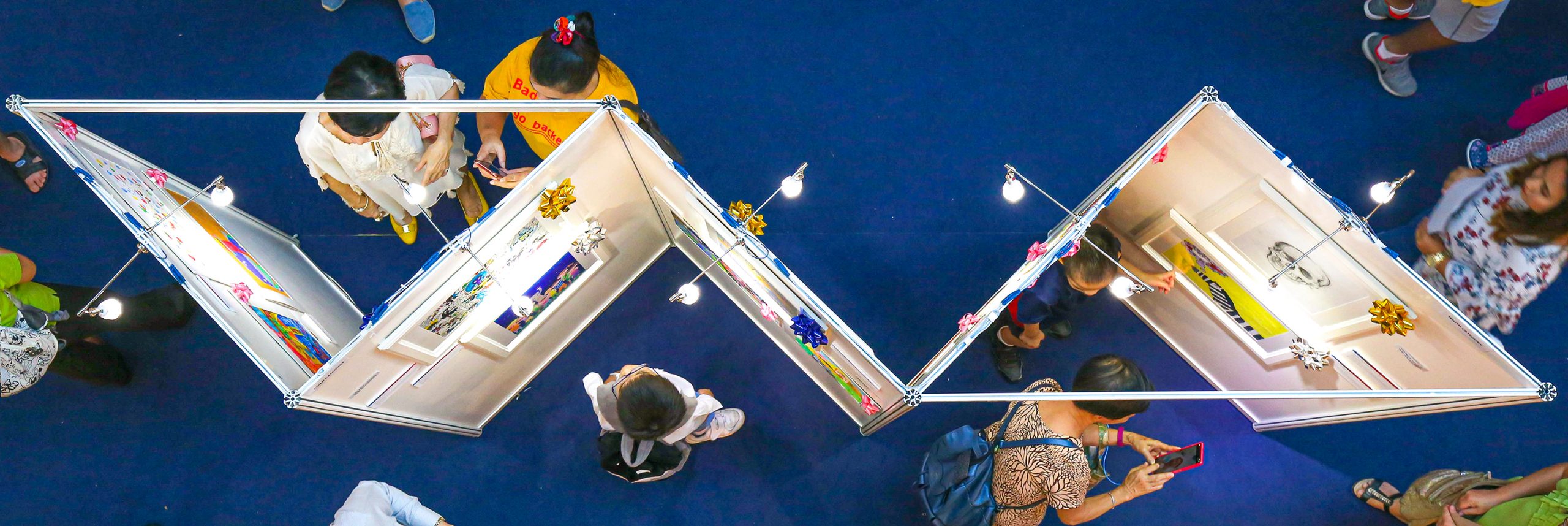
How many of us have attended a performance or an exhibition and seen someone with a disability in the audience or as a fellow visitor? This would have been quite an uncommon sight a decade ago. Today, most of our cultural venues like the Esplanade, the National Gallery, the Singapore Art Museum to name a few, all have an access team or access coordinator to support the access needs of visitors with disabilities, including invisible disabilities like autism. This has also led to more initiatives and programmes to make the arts more accessible to persons with disabilities (PwD), e.g. relaxed or sensory performances at the Esplanade or Deaf guided exhibition tours at the Singapore Art Museum.
In Special Education Schools, there has also been a dedicated look at arts education, with MOE launching a teaching and learning syllabus for visual arts in special education in 2021. This means that progressively we can expect more PwDs to have access to the arts an early on age in their school going years.
The last few years have been significant for the disability community in Singapore, with major milestones in the policy sphere, and innovations in accessibility across various sectors. This was similarly reflected by Mr Eric Chua, Senior Parliamentary Secretary (MCCY, MSF) at the recently concluded Arts & Disability Forum just last month. He also co-chairs the Enabling Masterplan 2030 which aims to guide cross sector efforts to create a more inclusive Singapore by 2030. Out of its 29 recommendations – Inclusive Arts & Heritage landscape was one key focal area.
It is critical to examine why the arts matter. And why we need the arts to be more inclusive for audiences and artists with disabilities. Mainstream narrative around disability or a person with disability often speaks about these individuals from a place of deficit, constantly reminding us of what they do not have. At ARTDIS (Arts and Disability Singapore), the organisation I lead, we fully believe that PwDs have unique strengths and perspectives different from non-disabled persons – and the arts helps us to uncover that. The arts also offers us a lens to understand who they are (even if they are non verbal), and a space to connect both the disabled and non-disabled to experience the world together.
I like to tell the story of Hugh Lee, an autistic young artist in training with us. I came across his painting one afternoon, which consisted of many concentric circles painted in black, shades of pink and shades of green. The circles were painted edge to edge against each other, with the artwork resembling microscopic cells. I had liked it very much as there was poetic beauty to the repetition of circles and his use of colours was visually attractive. A couple of weeks later, I discovered that he had shared that his work was about mathematical equations.
Perhaps it was the additions and subtractions involved in mixing the paints to get to the various different shades of pink and green. In that moment, I was offered a different perspective, and a door into his world of neurodiversity. A world so different from how I experience mine, and when invited in, reminds me that society is made up of diverse perspectives, and invites me to re-examine my own. It also reminded me to see the autistic youth as a person, and not their medicalised condition.
The growing awareness and accessibility support for audiences and visitors with disabilities in Singapore is a positive development that should be celebrated. It is a testament to the tireless efforts of disabled persons and their caregivers who have been advocating for greater inclusivity and accessibility. Yet, there is still more that needs to be done to support them. Here are some of the ways we can continue to make progress in this area:
First, we should not only provide accessibility to PwDs to attend arts events as audiences, but they should also be represented on mainstream stage productions and exhibitions. Whilst it is wonderful for a disabled person to be able to attend an arts event with accessibility accommodation, it is another for them to see another disabled person on stage, as part of a diverse cast, reflecting the diversity of society that is made up of both disabled and non-disabled persons. Culture informs our understanding of the world and shapes perspectives. If cultural events do not feature deserving disabled artists, it shapes a world for audiences that the social compact is only made up of non-disabled persons. And disabled persons in the audience will continue to feel they are excluded from society.
Second, and related to the first recommendation is that if we envision a future where disabled persons are included on mainstream stage and exhibitions, then we have to prepare them to be excellent arts practitioners, and give them the right opportunities to grow. They should not be included for good optics, but included because they are as equally as good as mainstream non-disabled performers. The reality is whilst there are increasing number of disabled persons enrolling in our local arts institutions, they continue to face many barriers to gainful industry employment. They need additional scaffolding including mentorships and access to networks that they had traditionally been excluded from due to a lack of access support.
Third, as more programmes and initiatives are being rolled out to provide access to PwDs, it is essential that arts workers and service providers understand how to work with people with disabilities, including what their access needs are, and how to provide reasonable and effective accommodations. And this is needed across the full ecosystem value chain including artist-educators who are going into SPED schools to facilitate art programmes, to creative and production teams in cultural venues.
Lastly, growing arts accessibility and inclusion for PwDs is a collective effort, it involves everyone. As an audience member or visitor yourself, you may encounter a PwD who is a fellow audience or visitor, sometimes this may mean holding the door for a wheelchair user as he/she navigates the heavy glass doors of the museum, or holding space for a caregiver whose neurodiverse child in the audience may be having a meltdown as a result of sensory overload.
Read the original mandarin version written by Angela Tan, Executive Director of ART:DIS.