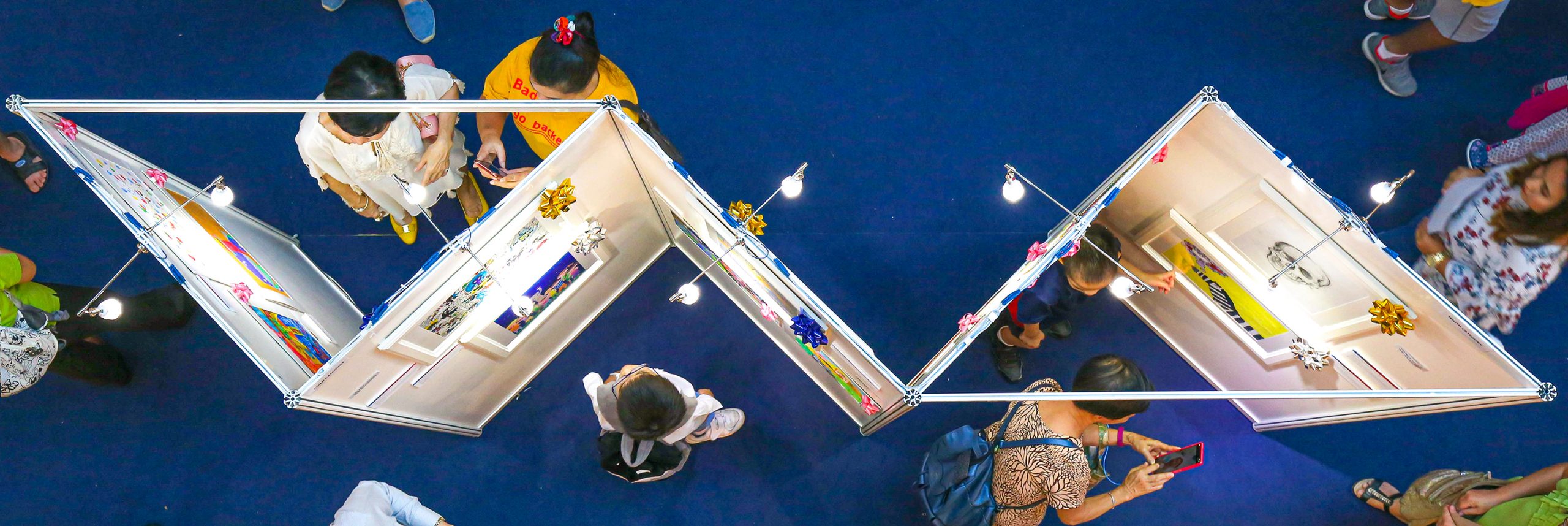
Selected participants get to be portrait subjects, as I did, amid a roomful of quiet observers. The Silent Studio experience by Isabelle hopes to encourage introspection and sensory engagement, as attendees immerse themselves in silence and Deaf culture.

What’s it like getting your portrait taken by a Deaf photographer?
Nov 30, 2025
, Channel News Asia
You assume you’re comfortable with silence after almost a decade of being a journalist. Interviewees don’t always open up the way you hope they would, but silence comes in shades – the considered pause of someone working through their thoughts versus the taut quiet of someone uneasy by what they aren’t quite ready to reveal.
I thought I’d become an expert at listening to words unsaid – until I was the subject. I had too many questions for the photographer, and no way to get my answers. At least not in the traditional sense.
Behind the lens was Isabelle Lim. Born with Nager syndrome, which is characterised by craniofacial and limb abnormalities, the rare genetic condition has also made her profoundly deaf since birth. But far from letting her condition stop her from living life to the fullest, 32-year-old Lim embraces her title as a Deaf photographer.
In 2015, a year before graduating from LASALLE College of the Arts, Lim founded her company issyshoots. She runs it with her mother Jacqui, who assists with interpreting among other tasks.
The 30-minute intimate portrait shoot on Thursday was designed to be just Lim and me, though – no interpreter, only her gestures and my feeble attempts at understanding. Members of the public may also experience it firsthand on Dec 6, as part of the Enabling Lives Festival which brings together over 80 partners to champion disability inclusion.
The Silent Studio Experience
From the get-go, Lim seemed to share my cardinal rule of interviewing: Model the behaviour you want to draw out in others. Easing into a high chair, I instinctively turned to my right. The proverbial “deafening silence” was causing a racket in my head: Where do I put my arm? Does my neck always sit like this? What’s up with my wonky eyes? And since when did breathing suddenly feel like advanced choreography?
Lim seemed to hear it all. Relax, she told me, by pressing her palms gently downward in the universal sign to loosen up. I dropped my shoulders, and she smiled.
I was a good student already, I thought, confident of my journalist’s ability to read body language. I got this.
Then she crossed her right arm over her left. I mimicked her, but she shook her head. The other way then? Left over right? Was she doing a mirror image? Either way, we finally got the shot.
Come, hop off the chair, she beckoned next. She stepped behind it and placed her arms on the backrest. Can you do that? Her expression read.
Maybe? After my previous communication hiccup, I wasn’t entirely convinced my brain could get my body to behave accordingly.
Lim valiantly, and very patiently, came to my rescue with a detailed demonstration. Stand just behind the chair, your stance open and steady. Rest your arms on the backrest, supporting your head. Tilt your head to the right, toward the studio lighting.
Finally grasping my chronic left-right confusion, she gave me the kind of look that needs no words: I’m just going to touch your arm and move it myself. She gently reached for my arm, quelling my internal panic.
I felt my expression fading from exhaustion, but at least this prompted instructions I could execute: Smile, please! Lim drew her fingers across her mouth. On the count of three – smile. And on three, I beamed.
From Feeling Isolated to Being Involved
Communicating with people has always been a challenge, Lim later shared in a conversation facilitated by Singapore Sign Language interpreter Fang Shawn. Growing up, she felt isolated and alone. She wanted to be part of the “hearing world”, she expressed, but hearing people usually don’t know how to approach the deaf.
I’d inadvertently been one of them mere minutes ago. I’d spoken to her interpreter, as he was able to respond verbally – only to be reminded I should address Lim directly. My biases checked, I could start to understand the negotiations she’d been making her whole life.
In primary school, Lim discovered the magic of photography through her Deaf teacher, who was a hobbyist photographer. He enjoyed taking photos of the class engaged in activities, often sharing slideshows of his pictures.
“What I realised is there’s a power in visual storytelling, because through his eyes … he showed me that photos can tell a whole story. You can say your emotions. I didn’t know that I don’t need to speak, and photos can speak for me.”
One day during a family gathering, Lim picked up her mother’s camera, looked through the lens and realised she was “actually involved” in the event now.
“Photography allowed me to take photos of my family or friends, and that was the start of communication for me.”
After setting up her company issyshoots, she took on weddings, family portraits and event photography, among others, and stopped feeling left out. Candid photos, in particular, are her favourite. The style allows her to “take photos on the fly”, without really having to communicate with the subject.
In her World, on her Terms
During our silent studio session, I heard Lim loud and clear. By creating an environment for hearing people to experience Deaf culture, she simply wanted participants like me to learn to meet others at their pace. It was less about nailing the perfect photo and more about showing what Deaf people – or anyone with disabilities – can do, allowing participants to slow down and connect with them “in their own way”.
“Here, at the silent studio, the roles are reversed. I’ve become the host. It gives me the opportunity to direct and control the pace and dynamics of the shoot,” she shared. As Lim moved gracefully around the studio, propping my arm up here, adjusting my stance there, I observed a woman born into a world of silence speak volumes through her presence.
The lack of noise sharpens her focus, she shared, helping her capture candid expressions while remaining acutely aware of everything happening around her. Yet even with her heightened visual awareness, not being able to hear inevitably comes with its own challenges. Predicting what happens next at events, for instance, is an art form she spent 10 years mastering, even though occasionally missing an emcee’s announcements about last-minute changes still sparks more than a little inconvenience.
You assume you’re comfortable with silence after almost a decade of being a journalist, until you become an interviewee. Suddenly you empathise with the reticent, who require more prodding than others. You even find yourself resonating with the occasional few who have the verbal range of a picture book, responding in a single word or grunt.
The absence of distraction somehow becomes its own distraction.
And yet, towards the end of my session with a Deaf photographer, I felt heard. The noise in my head finally settled, tapering off until it matched the quiet around me.